
 Română
- We will monitor allocations of state subsidies and spending;
- We will monitor the work of the Permanent Electoral Authority, the Court of Accounts and political parties and organise meetings to better understand how they do their work in this area;
- We will monitor the transparency of political funding – we will continue our series of annual reports looking at party funding. These reports have become an annual tradition since 2021 and highlight the main trends from previous years. In 2024, the report will be very relevant, especially as party funding is directly linked to campaign funding;
- We will monitor online political/electoral advertising – topics and spending;
- We will work with journalists and citizens interested in monitoring this topic;
- We will publish monitoring reports.
Monitor legislation and advocate for rules that are as clear and predictable as possible.
We will follow the legislative process (Parliament, Government, the PEA, electoral commissions, etc.) and intervene through legal instruments and public statements whenever necessary. Monitoring activities are designed to ensure that legislation complies with international standards and constitutional principles and does not restrict voters’ rights in any way. Furthermore, we will continue to promote the recommendations from previous elections – see also the database of election recommendations.
Monitoring the election administration
We will observe how the election administration works (the PEA, electoral commissions, other institutions involved in the process) and how the preparations for the elections take place. We will attend events, technical meetings or meetings of various institutions. We will ensure that its functioning respects some key principles: integrity, legality, effectiveness, independence, impartiality, transparency, accountability and inclusiveness.
Observing gender equality in politics and elections
EFOR is one of the few organisations that has monitored elections and political processes from the perspective of women’s participation and has advocated positive measures to encourage women to participate as actively as possible. During the 2020 elections, we were the only organisation that analysed and processed the little existing data on women’s participation in the electoral process and published detailed reports on the issue, reflecting visible violations of the law (Women in the 2020 local elections or Policy brief on political representation of women in Romania). These data allowed us to conclude that the share of women in politics is low and that the law is systematically violated; in the local elections, almost 5% of the lists should not have been accepted as they violate the law. Our data have been used by Parliament and other public institutions.
So we plan to continue to collect data, put pressure on the authorities to publish detailed information on candidates and ask political parties to include more women in eligible seats.
Accreditation of observers and publication of observation reports with the VotCorect Coalition
We will continue our traditional work of accrediting observers. So far we have worked with over 4000 observers, as EFOR or in partnership with other organisations (e.g. the FiecareVot Coalition). EFOR will prepare the accreditation of observers together with partners in the VotCorect Coalition, which we have set up for the 2024 elections. You will be able to follow the work of the coalition on the www.votcorect.ro platform.
We also aim to:
- Develop the www.votcorect.ro platform for the registration and training of election observers
- Accreditation of election observers – The coalition will accredit independent, non-partisan observers in polling stations in country and abroad.
- Training of accredited observers – We will provide online and offline training in several cities across the country. We will develop a manual for observers and a set of observation sheets for collecting data from polling stations, which will be collected using the Vote Monitor application (developed by Code4Romania). EFOR is the only organisation to have made the Observer’s Handbook public in previous elections so that it can be used by others, and the practice will continue in 2024.
- Election day monitoring in polling stations in country and abroad – We are not planning to cover all polling stations. In 2019, during the EP elections, we covered 3,000 polling stations with 1,200 observers. EFOR will provide electoral assistance to observers and guide them in resolving any incidents of violations.
- Publication of monitoring reports – After each election, we will publish a monitoring report on the electoral process, including an assessment of the organisation of the elections and recommendations for improvement. During the electoral process, the core team collects information on technical issues, including from visits to institutions that have a role in the electoral process. The report is distributed to all relevant institutions and contains conclusions on the organisation of the elections and recommendations for improvement of the process, in line with international standards. The reports are launched at public events, to which representatives of the main public institutions managing the electoral process – the Permanent Electoral Authority, representatives of the electoral offices, the Special Telecommunications Service, the Ministry of Interior and other institutions, parliamentarians, candidates, media, partners or other persons interested in the subject will be invited.
Electoral assistance for voters, observers and all those interested
- Assisting those in need during the election period has been one of EFOR’s priorities since 2014. In 2024, it will remain one of our priorities. To start with, we will update the www.votcorect.ro platform and organise an information campaign on the technical rules of the electoral process. The election assistance center consisting of the VotCorect platform and a call centre will provide constant updates on the organisation of the elections, provide and publish answers to voters’ frequently asked questions and debunk the main misinformation themes about the elections in real time. On Election Day we will provide electoral assistance to voters and observers via the Telverde 0800 080 200 service (and an overseas version), operated by legal and electoral experts. We will react quickly to any voting irregularities and refer complaints to the relevant institutions where appropriate. As a reminder, during the 2019 EP elections, more than 1200 people left complaints or asked questions to the team. The information campaign will include tools such as interactive maps that will allow voters to identify candidates or a database of all candidates since 2004.
Other topics of interest to EFOR
- Use of open data in electoral processes
- Monitoring electoral technologies
- Protection of personal data in electoral processes
Follow EFOR’s databases in the 2024 elections
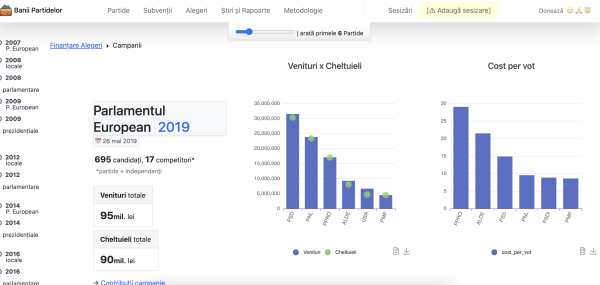
www.banipartide.ro – political finance since 2006
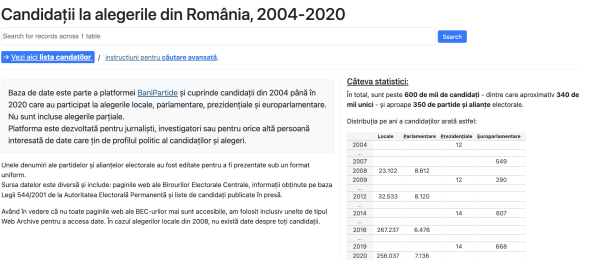
Election candidates – candidates since 2004
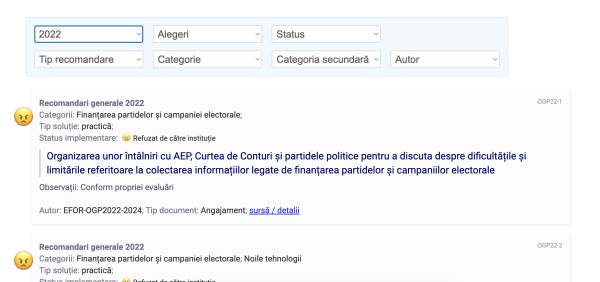
Election recommendations – all election related recommendations since 2009
For any questions related to the election observation campaign you can contact Septimius Pârvu, Election Programme Coordinator at septimius.parvu@expertforum.ro or 0787.638.315.