
Expert Forum analyzed data related to candidates in parliamentary elections and published a report on electoral competition, women’s participation in elections, procedures, appeals and process transparency.
General statistics
- For the 2024 parliamentary elections, more candidacies were submitted compared to the previous elections – 8302 in total. From the competitors who submitted candidacies to both chambers, 8,168 candidates were validated – 2,906 to the Senate and 5,262 to the Chamber of Deputies, to which are added 58 independent candidacies – 52 to the Senate and 6 to the Chamber of Deputies. In 2020, 7,136 registered, and in 2016, a number of 6,477 candidates
- From the national minority organizations (19), which submitted candidacies only to the Chamber of Deputies, 58 candidates were registered, who are on the lists of candidates in all counties.
- Independent candidates registered in 30 counties with the Chamber of Deputies and in 5 counties.
- The candidacies were submitted by 31 parties and organizations of minorities, to which are added 19 organizations of citizens belonging to national minorities, whose candidacies for all constituencies in the elections for the Chamber of Deputies remained final.
- No electoral alliances were registered in these elections.
- The most candidates were proposed by PSD – 639, SOS Romania – 636, PNL – 630, AUR – 621, Forța Dreptei – 619, UDMR – 596 and USR – 589

Electoral competition
- We calculated the electoral competition by relating the total number of candidates in each constituency to the number of seats available according to the law. In the Chamber of Deputies, the biggest competition is in Giurgiu (23 candidates/seat), Mehedinți (22), Călăraşi, Ilfov, Ialomița (21), and the smallest in Dolj, with 14. In Bucharest, the ratio is 15.
- In the Senate, the largest competition is 30 in Mehedinți, followed by Gorj and Brăila, with 29 and Giurgiu with 28. The smallest is in Bucharest, with 16. In the diaspora, it is 21 at CDEP and 26 at the Senate.


Rejected candidate lists
- More than 50 lists proposed by political parties to the Senate or the Chamber of Deputies were rejected by different electoral constituency commissions (BEJ). No lists were rejected from almost half of the constituency electoral offices.
- 8 decisions to reject independent candidacies were identified, of which 4 in Bucharest.
- Most of the candidacies rejected by the BEJs are related to incomplete documents, lack of supporting signatures or non-compliance with the article regarding the representation of both sexes on the candidate lists. In addition to the completely rejected lists, there are also partially accepted lists, by pointwise elimination of some candidates who did not meet the conditions. – see the list of rejected lists, together with the reasons for rejection in the report. We mention that Law 208/2015, art 52 (2) establishes that “The lists of candidates for the election of senators and deputies must be drawn up in such a way as to ensure the representation of both sexes, except for lists that contain only one candidate.”
- Not all BEJs’ rejection decisions were challenged in court. In other cases, although they were challenged, they were not ultimately upheld by the court.
- The list of the Forța Dreptei for the Senate was rejected on the grounds that it did not ensure the representation of both sexes. The PNL list for the Chamber of Deputies was also rejected. The appeals in court were not accepted, and the two parties do not have lists of candidates. The DREPT list for the Senate was rejected because one of the proposed candidates did not meet the conditions, and following his removal from the list, it no longer ensured the representation of both sexes. The decision was contested in court, and DREPT submitted the list to the Senate.
Complaints and appeals
- The analysis of appeals and appeals from the court shows that there were systematic appeals of the candidacies of some parties, among them AUR or SOS Romania.
- PSD appears in 47 court cases at the tribunal or appeal court level in the last month, and in more than half of them the appellant is Gheorghe Funar. In fact, his name appears in 103 cases in the last month, and among these are appeals regarding BEJ’s decisions accepting PNL candidacies.
- In the case of the AUR, numerous decisions of the BEJs were challenged by the same person. In addition to these, in the case of the AUR, appeals submitted by different people in several counties in the country were identified – it may be an effect of the information related to the rejection of the candidacy from Bistrita Năsăud.
- In the same way, we see that at SOS Romania, the candidacies were systematically challenged by one person in several counties in the country – the same person who also challenged the candidacy of Diana Șoșoacă in the presidential elections. Although we cannot see details related to the reasons for the appeals, from the solution of the Vrancea Court it appears that the request is made to hold “accountable those who tried to hijack the electoral process and undermine Romanian democracy”
Women’s participation in the electoral process
- Overall, the percentage of female candidates increased to 35%, from 29.5% in 2020 . In 2016, women represented 27.7% of all candidates. The percentages are relatively similar in the two chambers: in the Senate, women represent 34.7% of the candidates, and in the Chamber of Deputies, 37%. Among the independent candidates, only almost 8% are women in the Chamber of Deputies, and there is no female candidate in the Senate.
- Separately, if we analyze the 19 minority organizations that only run for CDEP, the percentage of women raises to 35%.
- Percentage-wise, out of the total, most candidates are in the diaspora (45%), Ilfov (43%) and Alba (40%), compared to the total number of candidates from the county. The least are in Timiș, Harghita and Arad (approx. 30%). In Bucharest, the percentage of candidates is 30%.
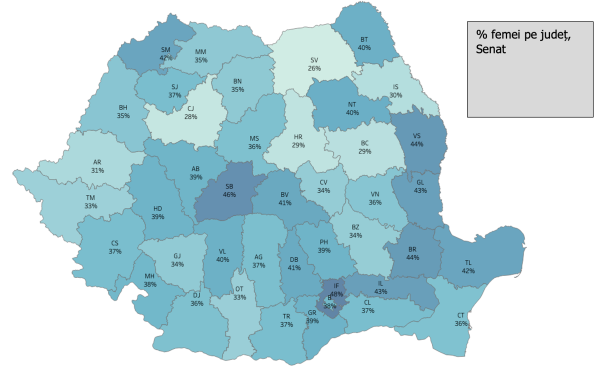
- In the Chamber of Deputies, the most women are registered in Ilfov and Alba (41%), respectively Hunedoara and Bucharest (40%). The lowest percentage can be found in Arad, Sibiu and Gorj (29%) and Călărași (28%). In the Senate, the most women are registered in Ilfov (48%) and Sibiu (46%), respectively Brăila and Vaslui (44%). The lowest percentage can be found in Suceava (26%) and Cluj (28%).

- Among the parties with more than 250 candidates validated at the national level, percentage-wise the most women are in SOS Romania (45%), PSDU and ADN (44%), PSDI (40%) or ANC (46%). PSD registered 33% female candidates, PNL 28%, USR 32%, AUR 29%, UDMR 35%, PRA 39%, FD 26%, REPER 38% or DREPT (37%). If we look in comparison to 2020, many parties have seen growth. For example, PSD had 26%, PNL 25%, USR 25% and UDMR 29%. AUR recorded a regression, from 30%.

-
- The most PSD candidates (percentage) are in Vâlcea, Ialomița and diaspora (50%), and the fewest in Covasna and Giurgiu (20%), respectively Vrancea and Harghita (18%).
- At PNL, the highest percentage of female candidates can be found in Vaslui (50%) and Mehedinți and Giurgiu (40%). In Timiș there are 16%, and in Dâmbovița only 14%.
- At USR, the most women are found in Vrancea (57%), Bucharest (48%) and Brașov (44%). The least are in Dâmbovița (14%).
- At AUR, the most women are in Ilfov (45%) and Mureș (44%), and the fewest in Teleorman, Caraș Severin and Alba (18%), respectively Harghita (10%).
- If we look at the positioning of female candidates on the lists – excluding minority organizations – only 23% of female candidates are on the 1st place, so below the percentage average. In the case of candidates in second place, a percentage of 38% are women, in third place 44%, and in fourth place 42%. So, if there are significantly more men in the first place, starting with the 2nd-3rd places, the difference is reduced. Even if there are more women registered in the electoral race than in the previous elections, their presence in eligible seats remains relatively low. In the Senate, the 2nd place candidates don’t matter in most cases. In the Chamber of Deputies, in case of good results, he can get up to 3-4 mandates (excluding Bucharest).
- No minority organization with a list of candidates longer than two people has placed a woman in the top seat. The Roma Party Association “Pro-Europe” or the Bulgarian Union of Banat-Romania included the first woman in the 4th place. In practice, women have no chance of being elected by such an organization.

-
- In the PSD, women represent 20% of the candidates in the first place, 30% of the candidates in the 2nd place and 41% of the candidates in the 3rd place. Between the 4th and 7th places, on average, the percentage is between 33% and 37%. In the Senate, the percentage of women is higher (36% vs 32%); the candidates in first place represent 19%, and those in second place 35%.
- PNL has 27% female candidates for the Chamber of Deputies and 29% for the Senate, and is one of the parties that offers limited access to women with opportunities. At the CDEP, only 12% of the candidates in the first place are women, 14% of those in the 2nd place, 29% of those in the 3rd place and 26% of those in the 4th place. In the Senate, in the first position on the list are 21% of candidates, 19% in 2nd place and 63% in 3rd place. Overall, the Liberals registered 16% women in 1st and 2nd place and 46% in 3rd place.
- USR has 29% women on the CDEP lists and 39% in the Senate. In the Chamber of Deputies, 14% of the candidates in first place are women, in second place 34%, and in third place 39%. In the Senate, there are 23% female candidates in first place, 50% in second place, and 34% in third place.
- AUR has 33% female candidates for the Senate and 27% for CDEP. On the first place in the Chamber of Deputies there are 28% female candidates, but only 9% in the Senate. At the CDEP, of the total number of candidates in the 2nd and 3rd places, women represent 14% each, and in the Senate, 28% and 56%.
- SOS Romania registered 44% of women from the total of candidates from the CDEP and 45% from the Senate. In the Chamber of Deputies, women in first place represent 21% of all candidates, those in second place 44%, and those in third place 40%. In the Senate, the respective percentages are: 23%, 43% and 60%.
- UDMR has 33% women on the CDEP list and 39% in the Senate. At CDEP, 30% are women in first place, 37% in second place, and 44% in third place. In the Senate, the corresponding values are 23%, 23% and 60%.
Transparency of data published by electoral commissions
- The candidacy proposals were published on the web pages of the constituency electoral commissions. The BEJs have published decisions accepting or rejecting candidacies. There is no unity in the way these documents are published, how they are made (the structure of the decisions) and in general the quality of the application documents displayed was low.
- The decisions of the electoral commissions issued to admit or reject the candidacy only record whether or not the legal conditions were met, the number of submitted signatures is not specified. Analysis of these decisions shows that not all are equally detailed.
- Some BEJs do not name the files suggestively, and whoever is interested in contesting the candidacies must open all the documents to understand what is the list submitted by a party. For example, on the BEJ Caraș Severin page, a user must open 50 decisions without names to see which ones are related to candidacies.
- The Central Electoral Bureau database includes minimal information, without allowing for more complex analyses. The database does not even contain information about profession or occupation, although in the data centralization process this information is collected, and this information is included in the candidature proposals displayed at the BEJ level.
- Expert Forum sent a request to the BEC on October 30 to expedite the display of data and the publication of data sets that also contain information on sex, age, profession and occupation. The BEC did not provide an answer to specific requests, but only informed us that the lists of candidates had been published.
Supporting signatures
- EFOR could not observe the signature validation process. Expert Forum requested the BEC on October 1 to observe the signature verification procedure. We were not allowed to observe the application validation process in the absence of a legal regulation regarding the observation of the process and for reasons related to the protection of personal data. However, it raises questions as to how some competitors collected almost 100,000 signatures (if they submitted in all constituencies) with very little visibility.
- The situation related to the BEC Decisions 3H of 16 September 2024 and 4 H of 19 September, which aimed to impose deadlines for the submission of supporting signatures by parties intending to submit lists in all constituencies, was not handled transparently (details in report).