
 Română
 Techniques: coordinated distribution, clickbait, and accidental viralization in the 2025 Facebook campaign
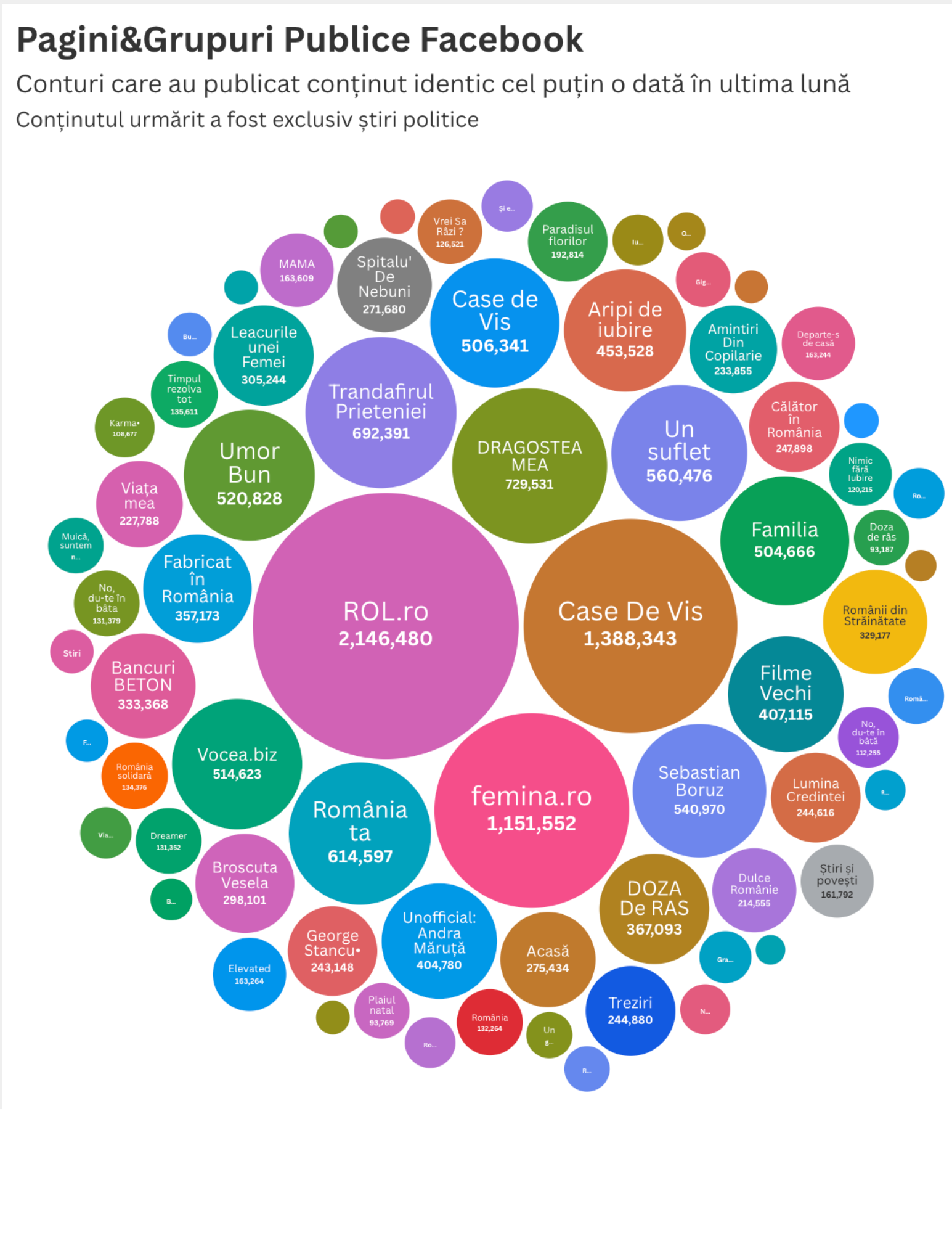
Facebook is already a common social network for Romanians, with over 11 million users in 2025. Information circulates intensely in public and private groups, on entertainment pages on Facebook, and elsewhere. EFOR monitors over 1,000 public pages and groups, and in many of them we observe clear patterns of coordinated distribution.
The content promoted often follows a sensationalist marketing logic, with the aim of generating visibility and engagement. Although these pages present themselves as apolitical and entertainment-focused, some of them end up giving increased visibility to certain issues or candidates.
In this context, it is justified to ask who gains the most attention in these digital spaces?
On TikTok, we have already documented an industry of artificially inflated accounts, likely used to be sold or rented for political campaigns. On Facebook, this phenomenon has an older and more refined infrastructure, perhaps because it has had time to adapt to the platform’s obstacles and a different pace of virality. But here too, anomalies abound. We are witnessing an invasion of clickbait content, with pages generating traffic for entertainment content. In the absence of real-life traceability and accountability for the marketing networks created, social networks are replacing television, but without any control over the source, purpose, or methods used.
This phenomenon must be viewed in the broader context of infiltration tactics: astroturfing in comments, fan accounts on TikTok, and entertainment pages on Facebook. Political “pills” are also slipping in among memes and celebrity news. At present, we can only ask ourselves: is this disguised political advertising or simply clickbait content for views? In our opinion, both scenarios are valid, given that we did not find a majority positive trend for any of the candidates.
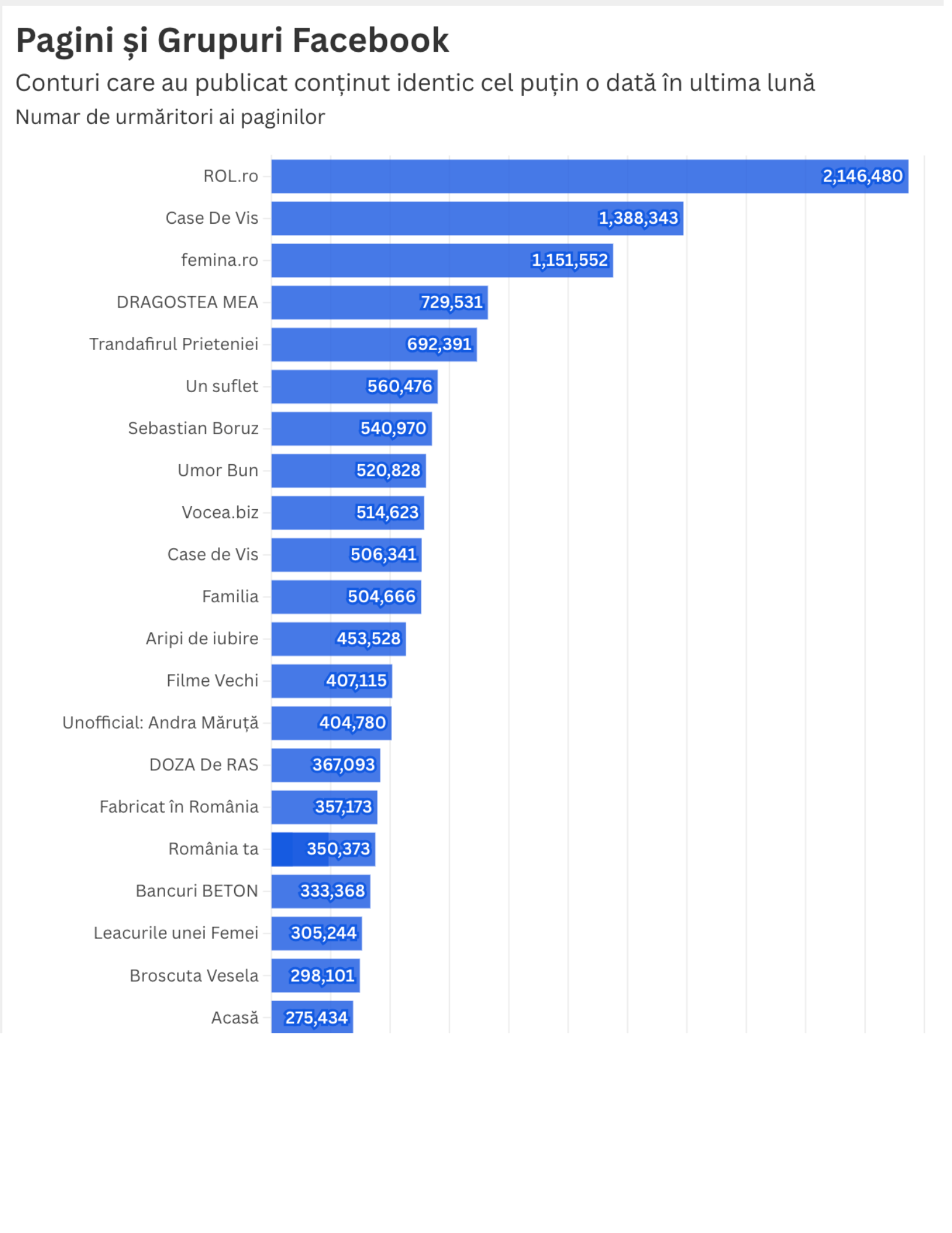
These types of repetitive messages can be easily found with a simple search. In this short report, we just want to show you a sample of the 194 entertainment pages that we have correlated with patterns that we consider coordinated, intended to pollute the information space in these presidential elections. It is not always clear whether they support one political camp or another. Often, they do not. It is like the AI photos of the “Romanian village,” which do not directly promote anything political, but only a feeling of well-being and nostalgia, yet generate traffic, interactions, and leave the user confused in a reality fabricated by fake accounts.
*Number of followers
Headlines of articles from the last 30 days that posted content about the two candidates
The content of the articles is a summary of public statements made by the two candidates. However, the clickbait headlines illustrate the promotion strategy, not the content on the website.
Top mentions George Simion Top mentions Nicușor Dan
BREAKING NEWS! George Simion’s decision has turned the debate upside down! The AUR leader’s gesture towards Elena Lasconi left everyone on the set speechless: “She is the only one who really…”.
Nicușor Dan makes a move that no one expected. Surprising decision taken by the candidate. Nicușor Dan said in a press conference that he is ready for an election debate in which George Simion will also participate. Nicușor Dan also presented his campaign strategy for the days remaining until the second round.
Who is George Simion’s wife and what does she do? Ilinca and the AUR leader have a little boy together. Who is Mirabela Grădinaru, Nicușor Dan’s partner, and what does she do?
It’s official: we now know what George Simion did in Vienna. What does the AUR say about the winner’s visit? “Mr. President George Simion produced several campaign materials (photos, video clips) for the second round of the presidential elections with renowned European politicians in the first part of the day.
Who will Nicușor Dan propose as prime minister if he wins the second round?
George Simion and Ilinca had a wedding like no other, with 42 pairs of godparents and thousands of guests attending the big event. Unlike him, the wife of the AUR leader is a discreet young woman, and after they got married, she has not been in the spotlight. George Simion receives the FIRST BLOW after the announcement of the presidential election results. A leading party in Romania announces its support for Nicușor Da
NEW official poll for the second round. The difference between George Simion and Nicușor Dan has changed dramatically in the most unexpected way BREAKING NEWS Earthquake on the Romanian political scene! Dan Șucu intervenes and makes a big demand of Nicușor Dan and George Simion It’s more vital than ever!
What is the age difference between George Simion and his wife, Ilinca? No one saw this coming! Traian Băsescu drops a bombshell: “Nicușor Dan has only one partner to convince for the second round.” Everyone thought of big names, strategic alliances, and spectacular scenarios — but no one expected this huge SURPRISE
Who is Ilinca, George Simion’s wife, and what does she do? She is 11 years younger than him and made him a father for the first time. How much does Nicușor Dan’s wife earn per month? Mirabela works in the automotive industry and earns an impressive amount.
Victor Ponta broke the silence with a statement that left everyone speechless when he saw that George Simion is currently in first place: Vica Blochina, a certified numerologist, analyzed the presidential candidates and gave her verdict: “He will win the election.”
Example
Content amplified by these sources: the case of Anamaria Gavrilă (POT)
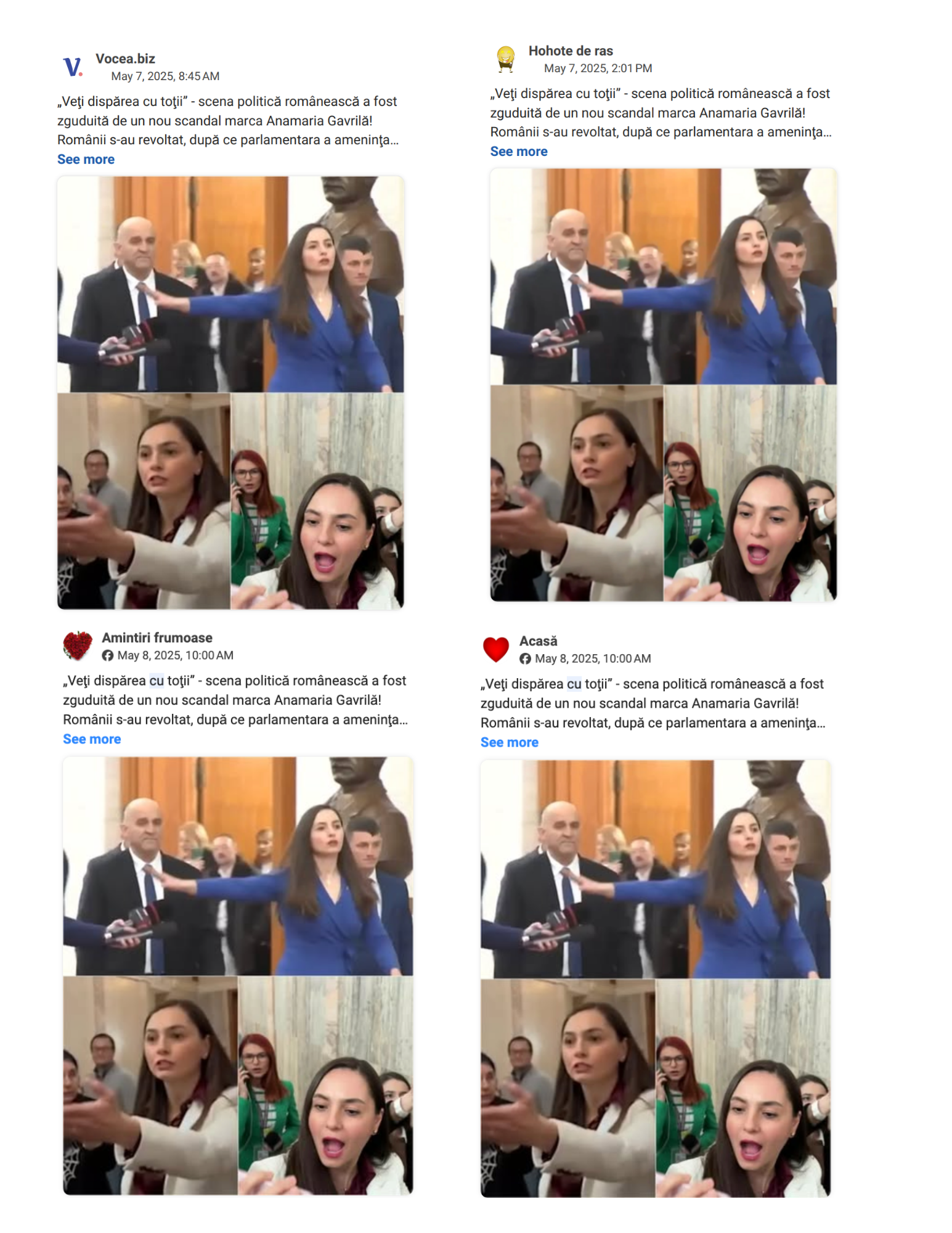
On May 7, 2025, several online publications reported an incident in which Anamaria Gavrilă, leader of the Young People’s Party (POT), made threats against the press and a party colleague. The statement “you are an endangered species” was filmed and distributed on social media, generating strong reactions from the public and fueling a wave of outrage. Gavrilă later posted a message on Facebook accusing the press of partisanship and reaffirming her support for “a free press that does not live off party money.”
This news item was picked up and amplified by several pages on the monitored network, which published an identical version of the same article. The pages in question generally present themselves as sources of entertainment or general news, with no declared political affiliation, but they contributed to the repetitive dissemination of this content. The amplification was not clearly aimed at supporting or attacking her, but at generating traffic by exploiting the viral and emotional potential of the topic, a strategy frequently observed in these networks.
Why do we think this episode is relevant? The example illustrates how networks of accounts that appear to be aimed at occupying the information space and populating it with entertainment content can pick up and redistribute controversial events at key moments, contributing to their overexposure in a way that is opaque and difficult to trace in terms of purpose and effectiveness. In the absence of transparency regarding the purpose or beneficiaries of the distribution, such networks can disrupt the public agenda and influence political perceptions in an indirect but systematic way.
Example 2
The news about Călin Georgescu, co-chair
After the second round of the 2025 presidential elections, several online pages disseminated an alleged public statement by Nicolae Voiculeț, associated by these sources with candidate George Simion, claiming that “Romania will have two presidents: George Simion and Călin Georgescu.” The speculative statement invoked the possibility of a constitutional amendment that would allow for a “co-presidency,” a concept that does not exist in the current legal framework and is unprecedented in Romania’s constitutional architecture.
This statement, although clearly fanciful from a legal and political point of view, was taken up and amplified by several pages in the analyzed network in a way that suggests an intention to create confusion and mislead voters. Unlike other cases of neutral or opportunistic redistribution, this example has a clear manipulative purpose: to present a false hypothesis as a possible or imminent fact at a critical electoral moment.
This is a representative case of how networks can function as multipliers of speculative, unvalidated, and deeply manipulative political content. Pseudo-constitutional scenarios distributed in this way contribute to eroding trust in the democratic process and amplify the effects of disinformation in a digital environment lacking editorial filters.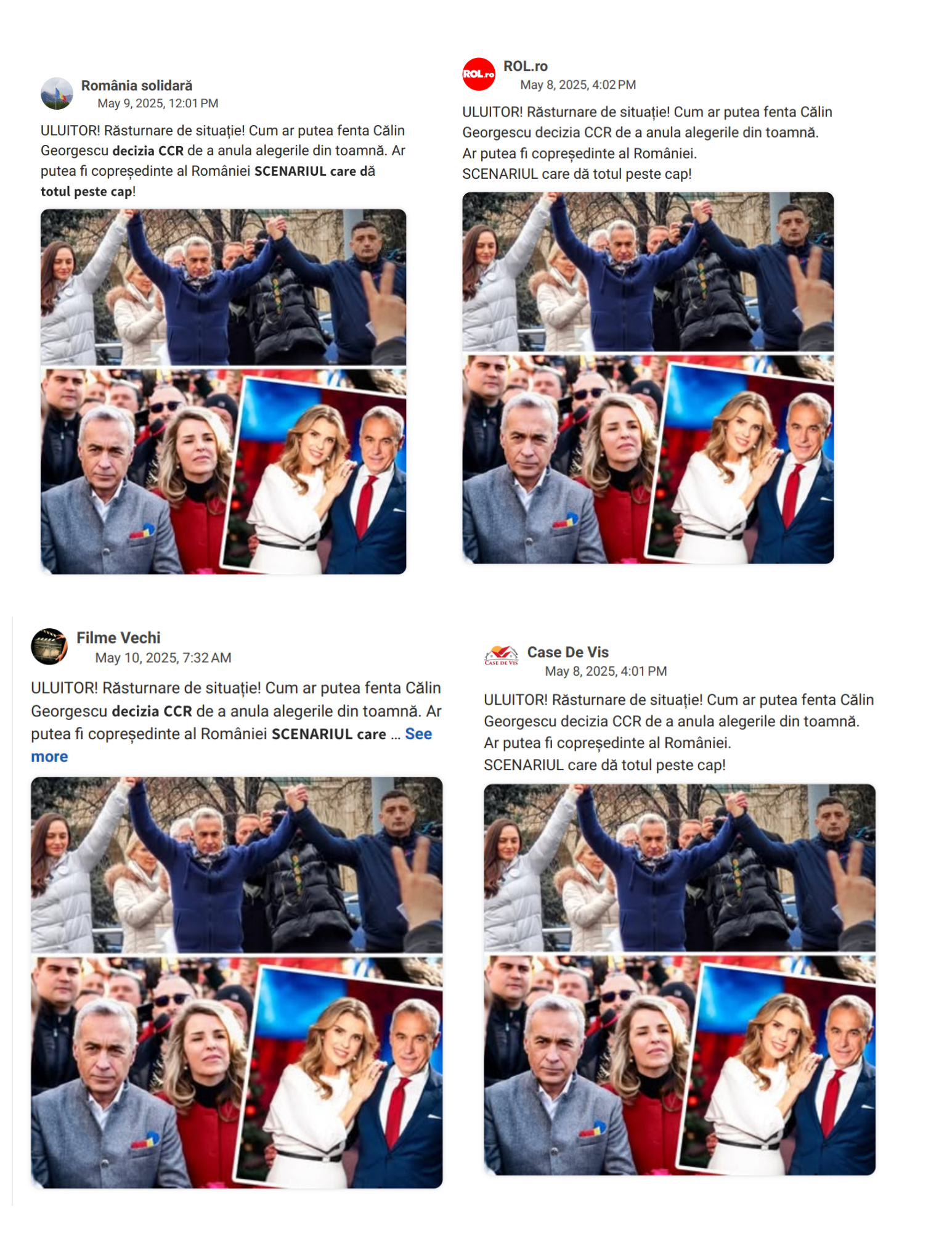
Example 3
Amplified content: “The 500,000 parasites in the public system”
On May 7, 2025, during the National Trade Union Bloc Congress, George Simion, leader of the AUR and candidate in the second round of the presidential elections, returned to the topic of reducing the budgetary apparatus, stating that “political parasites” are the ones blocking public administration. The news report states that Simion said that honest teachers, military personnel, and civil servants are not targeted, but rather “party members” who allegedly obtained positions through patronage.
George Simion’s statements were widely shared on these pages in a copy-paste style, with the same photo, graphics, and text. The case demonstrates how polarizing political statements can be quickly converted into content with the potential to influence voters emotionally and cognitively.

Example 4
Amplified content: Nicușor Dan’s call for an election debate
After the first round of the 2025 presidential elections, candidate Nicușor Dan publicly stated at a press conference that he was ready to participate in an election debate with George Simion. The news about Nicușor Dan’s statements was copied and pasted on several pages of the monitored network, especially political or content aggregator pages. The amplification of this information was most likely intended to capitalize on public interest in a possible debate between the two candidates, a topic with viral potential. This example shows how an election message, such as the organization of a debate, can be quickly amplified on networks of pages with coordinated activity, either for editorial reasons or to drive traffic.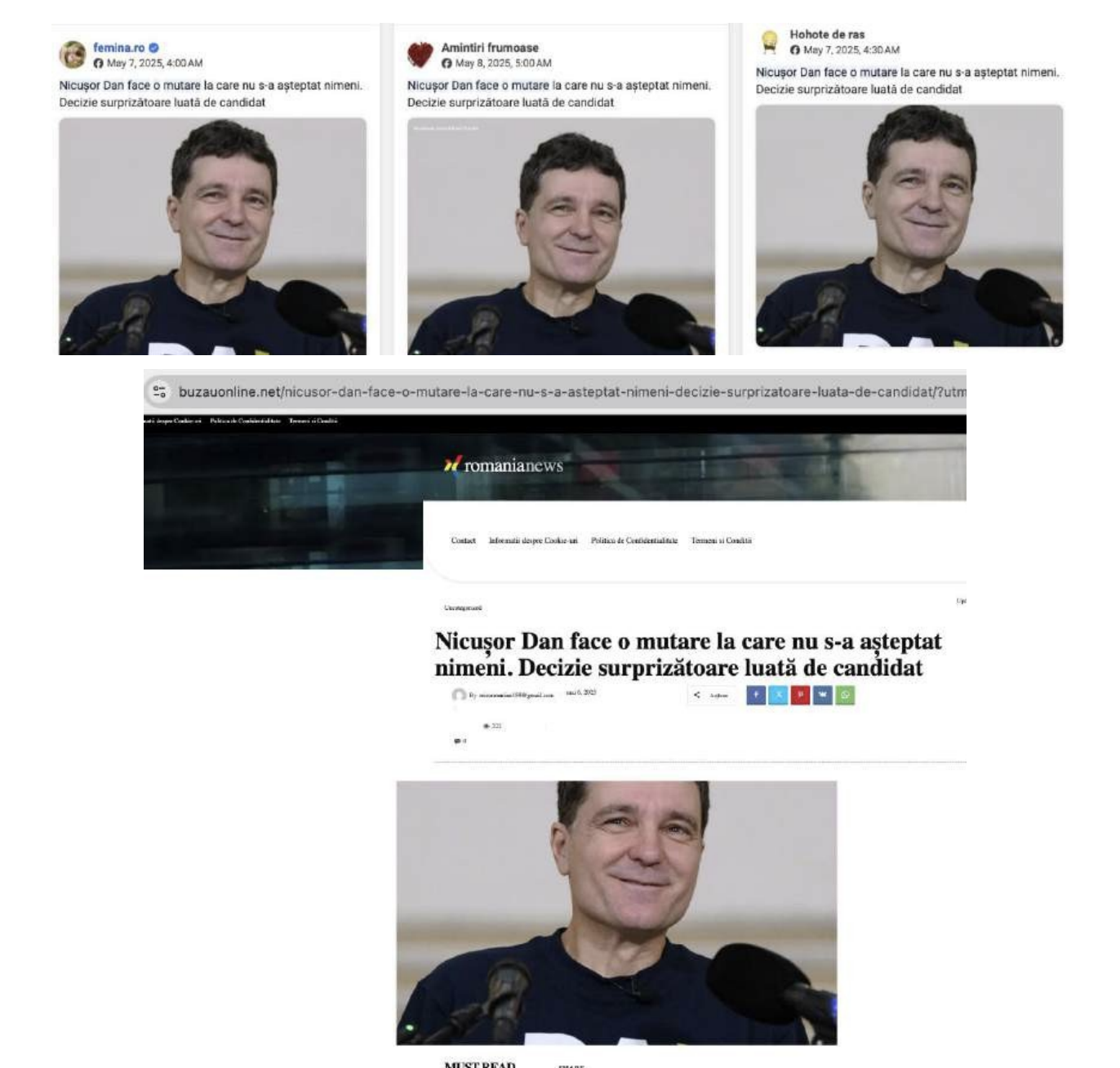
Networks of accounts can quickly amplify such messages in an obvious form of clickbait, without it being clear who is behind them or for what purpose. Without transparency and clear rules, there is a high risk that these networks will distort public conversation, especially during election campaigns. It is therefore essential to closely monitor how such content circulates and to understand who stands to gain from its propagation.
Is this content illegal? Not necessarily, but there are serious questions about where to draw the line. In many cases, the pages or accounts distributing coordinated content do not clearly violate platform rules or national legislation. We are rather in a gray area, which needs to be assessed on a case-by-case basis. Some distribution may be purely commercial or for traffic, while others may seek to manipulate public opinion, in which case they should be reported to the authorities.
In a digital landscape where pages appear and disappear at lightning speed, there is a risk that heavy-handed regulations or their ill-considered application will also affect legitimate content published by real people. Interventions must be carefully calibrated: they must avoid censorship and protect freedom of expression, contrary to the simplistic direction set by the Government through Emergency Ordinance 1 2025 or some decisions taken by the BEC. We are in a context where limited access to data significantly restricts the ability to investigate online coordination in depth. Under these circumstances, researchers are forced to maintain a fragile balance: on the one hand, to identify networks acting in concert, and on the other, to protect the fundamental right of users to express themselves freely, including anonymously. Fortunately, many of the propaganda strategies encountered are not sophisticated, relying more on volume and visibility than on precision, as the case analyzed in this report shows.